Ma trận + Đề kiểm tra giữa kì I Tiếng Anh 7 - Năm học 2023-2024 - Trường THCS Trường Sơn (Có đáp án + File nghe)
 13 Trang
84
13 Trang
84
Bạn đang xem tài liệu "Ma trận + Đề kiểm tra giữa kì I Tiếng Anh 7 - Năm học 2023-2024 - Trường THCS Trường Sơn (Có đáp án + File nghe)", để tải tài liệu gốc về máy hãy click vào nút Download ở trên.
Tóm tắt nội dung tài liệu: Ma trận + Đề kiểm tra giữa kì I Tiếng Anh 7 - Năm học 2023-2024 - Trường THCS Trường Sơn (Có đáp án + File nghe)
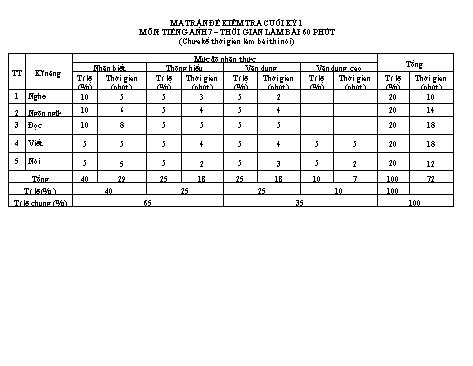
 MA TRẬN ĐỀ KIỂM TRA CUỐI KỲ 1
 MÔN: TIẾNG ANH 7 – THỜI GIAN LÀM BÀI: 60 PHÚT
 (Chưa kể thời gian làm bài thi nói)
 Mức độ nhận thức
 Tổng
 Nhận biết Thông hiểu Vận dụng Vận dụng cao
TT Kĩ năng
 Tỉ lệ Thời gian Tỉ lệ Thời gian Tỉ lệ Thời gian Tỉ lệ Thời gian Tỉ lệ Thời gian
 (%) (phút) (%) (phút) (%) (phút) (%) (phút) (%) (phút)
 1 Nghe 10 5 5 3 5 2 20 10
 2 Ngôn ngữ 10 6 5 4 5 4 20 14
 3 Đọc 10 8 5 5 5 5 20 18
 4 Viết 5 5 5 4 5 4 5 5 20 18
 5 Nói 5 5 5 2 5 3 5 2 20 12
 Tổng 40 29 25 18 25 18 10 7 100 72
 Tỉ lệ (% ) 40 25 25 10 100
 Tỉ lệ chung (%) 65 35 100 BẢNG ĐẶC TẢ KĨ THUẬT ĐỀ KIỂM TRA CUỐI KỲ 1
 MÔN: TIẾNG ANH 7 – THỜI GIAN LÀM BÀI: 60 PHÚT
 Số câu hỏi theo mức độ nhận thức
 Tổng Số
 Đơn vị kiến thức/kỹ Mức độ kiến thức, kĩ năng Nhận Thông Vận dụng
TT Kĩ năng Vận dụng CH
 năng cần kiểm tra, đánh giá biết hiểu cao
 TN TL TN TL TN TL TN TL TN TL
I. LISTENING 1. Nghe một đoạn hội Nhận biết:
 thoại trong 1.5j phút Nghe lấy thông tin chi tiết về một 2
 (khoảng 80 – 100 từ) để trong các chủ đề đã học.
 trả lời các dạng câu hỏi
 có liên quan đến chủ đề: Thông hiểu:
 Hiểu nội dung chính của đoạn độc
 Food and drink. 2 5
 thoại/ hội thoại để tìm câu trả lời
 đúng.
 Vận dụng:
 - Nắm được ý chính của bài nghe để 1
 đưa ra câu trả lời phù hợp.
 Nhận biết:
 2
 - Nghe lấy thông tin chi tiết.
 2. Nghe một đoạn độc
 Thông hiểu:
 thoại khoảng 1.5 phút
 - Hiểu nội dung chính của đoạn độc
 (khoảng 80 – 100 từ) liên 2
 thoại/ hội thoại để tìm câu trả lời 5
 quan đến một trong các
 đúng.
 chủ đề: Hobbies.
 Vận dụng:
 - Nắm được ý chính của bài nghe để 1
 đưa ra câu trả lời phù hợp.
 II. LANGUAGE Pronunciation Nhận biết:
 Nhận biết các âm thông qua các từ 2
 vựng theo chủ đề đã học:
 - Cách phát âm đuôi “s,es”
 - Cách phát âm đuôi “ ed”
 Thông hiểu:
 Phân biệt được các âm trong phần
 nghe.
 Vận dụng:
 Hiểu và vận dụng vào bài nghe/nói. 10 Vocabulary Nhận biết:
 Từ vựng đã học theo chủ Nhận ra, nhớ lại, liệt kê được các từ 2
 đề: Hobbies/ Heath/ vựng theo chủ đề đã học:
 Community services Thông hiểu:
 - Hiểu và phân biệt được các từ vựng 2
 theo chủ đề đã học.
 - Nắm được các mối liên kết và kết
 hợp của từ trong bối cảnh và ngữ
 cảnh tương ứng.
 Vận dụng: 2
 Hiểu và vận dụng được từ vựng đã
 học trong văn cảnh:
 + word choice
 + Communicative situation
 Nhận biết: 2
 Nhận ra được các kiến thức ngữ
 pháp đã học:
 Grammar
 - present simple/ past simple
 Các chủ điểm ngữ pháp
 Thông hiểu:
 đã học
 Hiểu và phân biệt các chủ điểm ngữ
 pháp đã học.
 - The present simple
 - The past simple
 Vận dụng:
 - Đoán nghĩa của từ trong văn cảnh.
 - Hiều, phân tích, tổng hợp ý chính
 của bài để chọn câu trả lời phù hợp.
III. READING Nhận biết: 5
 1. Cloze test Nhận ra được các thành tố ngôn ngữ 3
 Hiểu được nội dung và liên kết về mặt văn bản.
 chính và nội dung chi tiết Thông hiểu:
 đoạn văn bản có độ dài Phân biệt được các đặc trưng, đặc 1
 khoảng 80-100 từ về chủ điểm các thành tố ngôn ngữ và liên
 đề: Food and Drink. kết về mặt văn bản.
 Vận dụng:
 Sử dụng các kiến thức ngôn ngữ và 1
 kỹ năng trong các tình huống mới.
 2. Reading Nhận biết:
 3 5
 comprehension Thông tin chi tiết. Hiểu được bài đọc có độ Thông hiểu:
 dài khoảng 80-100 từ về - Hiểu ý chính của bài đọc và chọn
 chủ đề: Music and Art. câu trả lời phù hợp.
 - Hiểu được nghĩa tham chiếu. 1
 - Loại trừ các chi tiết để đưa ra
 câu trả lời phù hợp
 Vận dụng:
 - Đoán nghĩa của từ trong văn cảnh.
 - Hiều, phân tích, tổng hợp ý chính 1
 của bài để chọn câu trả lời phù hợp.
IV. WRITING Nhận biết:
 Nhận diện lỗi:
 1. Error identification
 - Comparison: as as 2
 Xác định lỗi sai
 - Từ loại (adj) trong câu
 Thông hiểu:
 2. Arranging Sắp xếp từ/ cụm từ gợi ý để hoàn
 Sắp xếp từ/ cụm từ gợi ý thành câu
 3
 để hoàn thành câu - Comparison
 - Compound sentence
 - Present simple tense
 Vận dụng: 2 8
 3. Sentence
 Hiểu câu gốc và sử dụng các từ gợi ý
 transformation
 để viết lại câu sao cho nghĩa không
 Viết lại câu dùng từ cho 2
 thay đổi.
 trước.
 - Why don’t we + to V ?
 - should + V(bare)
 Vận dụng cao:
 4. Sentence Building Sử dụng các từ, cụm từ đã cho để
 Sử dụng từ/ cụm từ gợi ý viết thành câu hoàn chỉnh.
 3
 để viết câu. - The present simple
 - The past simple
 - The present continuous
 V. SPEAKING (Phần SPEAKING tổ
 chức thi buổi riêng)
 + Nội dung:
 - Hỏi - đáp và trình bày về các nội dung liên
 quan đến các chủ điểm
 có trong chương trình.
 - Sử dụng được một số
 chức năng giao tiếp cơ
 bản như hướng dẫn, bày
 tỏ ý kiến, hỏi đường, hỏi
 thông tin và cung cấp
 thông tin,
 + Kỹ năng:
 - Kỹ năng trình bày một
 vấn đề; sử dụng ngôn
 ngữ cơ thể và các biểu
 đạt trên khuôn mặt phù
 hợp; kỹ năng nói trước
 đám đông
 + Ngôn ngữ và cấu trúc:
 - Ưu tiên sử dụng những
 cấu trúc đã học trong
 chương trình.
 (Các chủ đề nói trong
 phần ghi chú)
 Nhận biết:
 - Giới thiệu các thông tin về bản
 1. Introduction 5%
 thân/ sở thích/ về thầy cô, mái
 trường/ môn học yêu thích.
 Thông hiểu:
 - Sử dụng kiến thức ngôn ngữ đã học
 để nói theo chủ đề.
 1
 Vận dụng:
 2. Topic speaking bài*
 - Sử dụng từ vựng và cấu trúc linh
 5%
 hoạt, diễn tả được nội dung cần nói
 theo những cách khác nhau. Phát âm
 tương đối chuẩn.
 Vận dụng cao:
 1
 - Hiểu và trả lời được câu hỏi của
 bài*
 3. Q&A giám khảo và trả lời một cách linh
 10
 hoạt. Sử dụng ngôn ngữ một cách tự
 %
 nhiên và thuần thục.
Tổng 14 2 6 6 5 3 0 4 25 15 UBND HUYỆN AN LÃO BÀI KIỂM TRA CUỐI HỌC KỲ I
 TRƯỜNG THCS TRƯỜNG SƠN NĂM HỌC 2023-2024
 MÔN: TIẾNG ANH 7
 Thời gian làm bài: 60 phút
PART ONE: LISTENING (2pts)
I. Listen and choose the correct answers: (1.0 pt) I. Listen to the conversation between Naomi and
Tuan. Circle the best answer A, B, or C. You will listen TWICE. (1.0 pt)
1. How did Naomi go to Da Nang?
 A. By plane.
 B. By taxi.
 C. By ship.
2. Why does Tuan suggest a glass of orange juice?
 A. Because it’s a yummy drink for summer.
 B. Because she wants to drink something first.
 C. Because it can help Naomi get over her tiredness.
3. According to Tuan, what ingredient does banh xeo NOT have?
 A. Shrimp.
 B. Pork.
 C. Bean sprouts.
4. What food do they agree to choose for their breakfast?
 A. Banh xeo.
 B. Mi quang.
 C. Banh xeo and mi quang.
5. Where is Tuan’s favourite restaurant?
 A. In a busy street.
 B. In a small town.
 C. In a narrow lane.
II. Listen to a girl talking about her hobby. Decide whether the sentences are true (T) or false (F).
Circle T or F. You will listen TWICE. (1.0 pt)
 T F
1. He started reading when he was over 4 years old.
2. He likes J.K. Rowling because of the sense of humor in her books.
3. Reading books doesn’t help him in learning English very much.
4. He enjoys reading because he likes to explore the imaginative world
5. He thinks he might become a writer one day.
PART TWO: LANGUAGE (2.0 pts)
I. Choose the word whose underlined part is pronounced differently from that of the others in each
group. (0,4pt)
1. A. watches B. misses C. makes D. wishes
2. A. talented B. closed C. gifted D. needed
II. Choose the word that does not belong to the group of the other three (0,4pt)
1. A. violin B. artist C. saxophone D. guitar
2. A. portrait B. opera C. camera D. photograph III. Circle the correct answer (1,2 pt)
1. Waiter: “ How many cans of beer would you like?”
Mary: _______
A. Yes, I’d love to B. No, I wouldn’t C. Yes, thanks D. two, please
2. We always go on holiday with classmates_______ summer.
A. in B. at C. on D. of
3. Jenny ___________ two eggshells last week and he will continue the third one.
A. carves B. has carved C. carved D. will carve
4. You ___________ study harder instead of chatting too much.
A. can’t B. musn’t C. should D. should not
5. A ___________ is a small meal that she eats whem she is in a hurry.
A. snack B. fast food C. breakfast D. lunch
6. ___________ bottles of milk does your family need for a week?
A. How much B. How many C.How long D. How often
PART THREE: READING (2.0 pts)
I. Choose the correct answer A, B, C or D to fill each blank in the following passage. (1.0 pt)
 Rice is (1) _______by Vietnamese people every day. It often grows in tropical countries such as
Vietnam, Thailand or Malaysia. The Chinese have also been growing rice for (2) _______ years. The
seeds are planted in special beds to grow into young rice plants. Then they are taken to fields covered (3)
_______muddy water called paddies. The fields of rice look very (4) _______ . After 3 or 5 months, the
rice is ready to be picked. People often drain away water before collecting rice. Eating rice is a special
action in the world. They don't use spoons or forks to enjoy bowls of rice (5) _______,they use two short
sticks known as chopsticks to put rice into their mouths. China and Vietnam are two countries in which
people use chopsticks very well.
1.A. used B. taken C. eaten D. boiled
2.A. thousands B. thousand C. thousand of D. thousands of
3.A. in B. by C. with D. of
4.A. beauty B. beautiful C. beautifully D. the beauty
5.A. However B. Moreover C. Besides D. Instead
II. Read the text carefully then answer the questions. (1.0 pt)
 Have you ever seen a water puppet show? It is so special and fantastic. It’s a unique Vietnamese
tradition. Children love the performance, and tourists who come to Viet Nam greatly enjoy this kind of art.
 Water puppetry is a traditional art form. It began in the 11th century. It originated in the villages of
the Red River Delta of North Viet Nam. The show is performed in a pool. The puppets are supported by
strings under the water and controlled by the puppeteers behind a screen, so they appear to be moving on
the water. The puppets are made of wood and then painted.
 The themes of the puppet show are rural: the performances show everyday life in the countryside
and folk tales. There are stories about rice farming, fishing, and Vietnamese village festivals.
1.When did water puppetry begin?
2.Where does a water puppet show take place?
3.Who are the puppets controlled by?
4.What are the puppets made of?
5.What are water puppet shows normally about?
 PART FOUR: WRITING (2.0 pts)
I. Make letter A, B, C or D to indicate the part that is incorrect. (0.4 pt)
1. This camera is not as expensive than I thought at first.
 A B C D
2. The students were not interested in history because it was bored .
 A B C D
II. Rearrange the words to make meaningful sentences (0.6pt)
1. Piano / is / heavier / much / other / than / instruments.
 ...................................................................................................................................................................
2. Many foreigners/ very /because /like Vietnamese food /to eat /it is/ strange/ and interesting/.
 ...................................................................................................................................................................................
3. How /fruits/ and/ much /vegetables /you eat/ in/ do/ a day/?
 ...................................................................................................................................................................................
III. Complete each of the sentences below in such a way that its meaning is similar to that of the
original one. (0.4 pt)
1. Let’s pay a visit to Huong Pagoda.
 Why don’t .
2. Children should participate in outdoor activities with their friends.
 Children should take .
IV. Complete the sentences using the given words (0.6 pt)
1. She/ usually/ visit/ school garden/ once/ week.
2. We/ see/ our new teacher/ school gate/ a few days ago.
3. There/ be/ big traffic jam/ road/ to/ city’s airport/ now.
 - The end - ỦY BAN NHÂN DÂN HUYỆN AN LÃO ĐÁP ÁN BÀI KIỂM TRA CUỐI KÌ I
 Trường THCS Trường Sơn MÔN : TIẾNG ANH 7
 Năm học 2023-2024
 Thời gian: 60 phút
PART ONE: LISTENING (2pts)
I. Listen to the conversation between Tom and Jack. Circle the best answer A, B or C. You will
listen TWICE. (1.0pt)
Script:
Naomi: Hello, Tuan. Long time no see.
Tuan: Welcome to Da Nang, Naomi. When did you arrive?
Naomi: Just yesterday evening. I felt quite tired after such a long flight.
Tuan: Oh, I see. Let me get you a glass of orange juice. It can help you feel better.
Naomi: Thanks a lot. But I just want something to eat first. Can you recommend any popular specialties
here?
Tuan: Would you like to try mi quang or banh xeo? They’re so yummy.
Naomi: Both sound strange to me. What are they?
Tuan: Mi quang is a kind of pork noodle soup served with different green vegetables while banh xeo is a
type of crepe made of rice flour, turmeric, shrimp and bean sprouts.
Naomi: Sounds delicious. I think I’d like to eat mi quang first. Soup is always a good choice for a healthy
breakfast.
Tuan: I couldn’t agree more. I’ll take you to my favourite restaurant. It’s in a narrow lane over there.
Key: 1. A 2. C 3. B 4. B 5. C
II. Listen to a friend talking about his favorite hobby as reading books. Then decide if the
statements below are true (T) or false (F). (1.0pt)
Script:
 My favourite hobby is reading. I enjoy reading a book when I have time.
I started to do it when I was four years old. The first time I did it, I felt interested. So I kept reading. The
teachers always taught me to read the difficult words. I was happy when I read a story with a happy
ending. I was thrilled when I read a detective story. I enjoy reading because I like to explore the
imaginative world of my favourite author, J.K.Rowling who writes “Harry Potter”.
 There are a lot of advantages of reading. Reading can make me relaxed and calm. I can also learn
new vocabulary items. Then I can further improve my English. Moreover, it can give me an unlimited
imagination, so I can write books in the future. I can learn the different cultures of other countries in the
world too. I read at least one hour every day. I read books by myself at home. I wish I could read different
kinds of books because it might be very challenging.
Key: 1. F 2. F 3. F 4. T 5.T
 PART TWO: LANGUAGE (2.0 pts)
I. Choose the word whose underlined part is pronounced differently from that of the others in each
group. (0.4pt)
1. C.
2. B
II. Choose the word that does not belong to the group of the other three (0,4pt)
1.B.
2.B.
III. Circle the correct answer(1.2pt)
1. D 2. A
3. C
4. C
5. A
6. B
PART THREE: READING (2.0 pts)
I. Choose the correct answer A, B, C or D to fill each blank in the following passage. (1.0 pt)
1. C
2. D
3. C
4. B
5. D
II. Read the text carefully then answer the questions. (1.0 pt)
1. It began in the 11th century.
2. It takes place in a pool.
3. The puppets are controlled by the puppeteers behind a screen.
4. The puppets are made of wood .
5. Water puppet shows are normally about rice farming, fishing, and Vietnamese village festivals.
PART FOUR: WRITING (2.0pts)
I. Make letter A, B, C or D to indicate the part that is incorrect. (0.4pt)
1. C
2. D
II. Rearrange the words to make meaningful sentences (0.6pt)
1. Piano is much heavier than other instruments.
2. Many foreigners like to eat Vietnamese food because it is very strange and interesting.
3. How much fruits and vegetables do you eat in a day ?
III. Complete each of the sentences below in such a way that its meaning is similar to that of the
original one. (0.4 pt)
1. Why don’t we pay a visit to Huong Pagoda.
2. Children should take part in outdoor activities with their friends.
IV. Complete the sentences using the given words (0.6 pt)
1. She usually visits school garden once a week.
2. We saw our new teacher at the school gate a few days ago.
3. There is a big traffic jam on the road to the city’s airport now.
 The end SPEAKING TEST
This test consists of 3 parts as follow:
Part 1: INTRODUCTION (0.5pt)
Talk about yourself (personal information and your hobby)
Part 2: TOPIC SPEAKING (1.0pt)
 Use some suggested topics below.
Part 3: QUESTIONS AND ANSWER (0.5pt)
Answer the teacher’s questions on the topic.
 SPEAKING SUGGESTED ANSWERS
Part 1: INTRODUCTION (0.5pt)
1.What do you like doing in your free time?
2.When did you start this hobby?
3.How much time a week do you spend on your hobby?
4.Who do you often share your hobby with?
5.Do you think your hobby is safe or dangerous? Why?
Part 2: TOPIC SPEAKING (1,0pt)
Topic 1. Talk about your hobby:
- What’s the name of your hobby?
- When did you start your hobby?
- Is your hobby easy or difficult? Why?
- Is your hobby useful? Why? Why not?
- Do you intend to continue your hobby in the future?
Topic 2. Talk about your best friend’s hobby:
- What’s the name of his/ her hobby?
- When did he/ she start his/ her hobby?
- Is his/ her hobby easy or difficult? Why?
- Is his/ her hobby useful? Why? Why not?
- Do he/ she intend to continue his/ her hobby in the future?
Topic 3. Talk about calories used for everyday activities and give advice on healthy lifestyle.
- What activities do you do everyday?
- How long do you do them everyday?
- How many calories do you use doing these activities?
- Give some advice on healthy lifestyle.
Topic 4: Talk about your volunteer work in the neighborhood
- Have you ever done any volunteer work in your neighborhood?
- Do you like volunteer activities?
- Why do you want to do volunteer work?
- How are you going to do it?
- Do you know any volunteers?
- What’s the benefit of doing volunteer work?
- Who do you think benefit from volunteer work?
- Was there anything that made you happy with your work?
Topic 5: Talk about your favourite singer.
 - Do you like listening to music?
- What types of music do you like? Why?
 -Who is your favourite singer?
- Name some of his/ her songs.
- Which song do you like best? / Why?
- When do you often listen to his/ her song? - Do you want to become a singer in the future? Why/ Why not?
Topic 6: Talk about your favourite food.
-What is your favourite food?
- What are its ingredients?
- How does it taste?
- Where can we enjoy it?
- How often do you eat it?
- How much does it cost?
- Can you cook it?
Topic 7: Talk about your favourite drink.
-What is your favourite drink?
- What are its ingredients?
- How does it taste?
- Where can we enjoy it?
- How often do you drink it?
- How much does it cost?
- Can you make it?
Topic 8: Talk about the first university in Viet Nam
- What is the name of the first university in Viet Nam?
- When was it founded?
- Why was it successful?
- Who was one of the most famous teacher at the Imperial Academy?
- What is another special thing about it?
Part 3: QUESTIONS AND ANSWER (0.5pt)
Answer the teacher’s questions on the topic:
- How many hours do we need to sleep a day?
- How should you keep your room?
- What should you do when your eyes are tired?
-
File đính kèm:
- ma_tran_de_kiem_tra_giua_ki_i_tieng_anh_7_nam_hoc_2023_2024.docx
 Listening 2.mp3