Đề kiểm tra năng lực Tiếng Anh Lớp 9 - Năm học 2019-2020 - Trường Quốc tế Á Châu
 9 Trang
168
9 Trang
168
Bạn đang xem tài liệu "Đề kiểm tra năng lực Tiếng Anh Lớp 9 - Năm học 2019-2020 - Trường Quốc tế Á Châu", để tải tài liệu gốc về máy hãy click vào nút Download ở trên.
Tóm tắt nội dung tài liệu: Đề kiểm tra năng lực Tiếng Anh Lớp 9 - Năm học 2019-2020 - Trường Quốc tế Á Châu
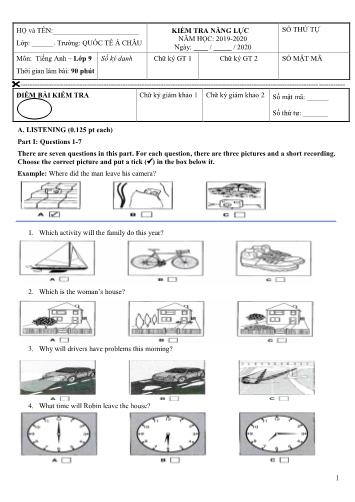
HỌ và TÊN:________________________ KIỂM TRA NĂNG LỰC SỐ THỨ TỰ NĂM HỌC: 2019-2020 Lớp: ______. Trường: QUỐC TẾ Á CHÂU Ngày: ____ / _____ / 2020 Môn: Tiếng Anh – Lớp 9 Số ký danh Chữ ký GT 1 Chữ ký GT 2 SỐ MẬT MÃ Thời gian làm bài: 90 phút ---------------------------------------------------------------------------------------------------------------------------------------- ĐIỂM BÀI KIỂM TRA Chữ ký giám khảo 1 Chữ ký giám khảo 2 Số mật mã: ______ Số thứ tự: _______ A. LISTENING (0.125 pt each) Part I: Questions 1-7 There are seven questions in this part. For each question, there are three pictures and a short recording. Choose the correct picture and put a tick () in the box below it. Example: Where did the man leave his camera? 1. Which activity will the family do this year? 2. Which is the woman’s house? 3. Why will drivers have problems this morning? 4. What time will Robin leave the house? 1 Part III: Questions 14-19 You will hear a radio programme giving you information about the city of Glasgow. For each question, fill in the missing information in the numbered space. GLASGOW Arrival by car * City center car parks are (14) _________________. Leave car at hotel. ‘Discovering Glasgow’ tour bus *Departs from George (15) _________________ every 30 minutes. *Buy tickets from (16) ________________. Walking *Go to Welcome Centre for information – free (17) _________________ available. Places to visit *Glasgow Cathedral – built in fifteenth century. *Merchant City area – shops selling (18) ________________ and clothes. *Byres Road – student area. *Botanic Gardens – glasshouses close at (19) _______________. B. READING COMPREHENSION (0.125 pt each) Part I: Look at the picture and choose the answer (A, B, or C) that best describes it. 20. A. You must show a receipt if you want to remove your luggage. B. When you remove your luggage, you are given a receipt. C. You can leave your luggage here without change. 21. For the festival, Anna should bring A. her ticket. B. a blanket. C. the programme. A. Don’t turn the lights on until it’s necessary. 22. B. Switch the lights on when you’re in the room. C. Don’t leave the lights on if the room is empty. 3 Group day and residential courses We also offer day and long weekend courses for groups. We receive regular visists from schools, colleges and youth groups. There are three large rooms with twelve beds in each, which can be booked in advance for groups of up to 36 people (minimum 12). Summer adventure holidays (for 8-14 years of age) Sailing Climbing Windsurfing Fun Games Safety is of primary importance at the Outdoor Center. All staff are fullly trained in First Aid, and qualified to teach the activities on offer. We also make certain that all children only take part in activities that are suitable for their age and physical abilities. For this programme children must be able to swim 25 meters and be in good physical health. 25. In August, four people visiting the centre together by car would pay more than two people. _____ 26. The centre has activities for a range of age groups. _____ 27. There are windsurfing courses every weekend. _____ 28. The centre has special equipment for people who are learning to windsurf. _____ 29. There is an extra hire charge for the board on the windsurfing course. _____ 30. The adventure course is suitable for beginners. _____ 31. The centre is planning to add extra facilities to the Play Park. _____ 32. It is possible for individual visitors to stay overnight at the centre. _____ 33. On the holiday programme children are allowed to do any sport they are interested in. _____ 34. Summer adventure holidays are open to any child between eight and fourteen years who can swim. _____ Part III: Read the text below and choose the correct answer for each question. Atlantic College Last week I went to visit Atlantic College, an excellent private college in Wales. Unusually, it gives young people much needed experience of life outside the classroom, as well as the opportunity to study for their exams. The students, who are aged between 16 and 18 and come from all over the world, spend the morning studying. In the afternoon they go out and do a really useful activity, such as helping on the farm, looking after people with learning difficulties, or checking for pollution in rivers. One of the great things about Atlantic College students is that they come from many different social backgrounds and countries. As few can afford the fees of £20,000 over two years, grants are available. A quarter of the students are British, and many of those can only attend because they receive government help. “I really admire the college for trying to encourage international understanding among young people”, as Barbara Molenkamp, a student from the Netherlands, said. “You learn to live with people and respect them, even the ones you don’t like. During the summer holidays my mother couldn’t believe how much less I argued with my sister.” To sum up, Atlantic College gives its students an excellent education, using methods which really seem to work. 35. What is the writer trying to do in the text? A. give an opinion about a particular student B. give an opinion about a special type of education C. describe the activities the students do in their free time D. describe his own experience of education 5 C. WRITING Part I: Complete the second sentence so that it means the same as the first, USING NO MORE THAN THREE WORDS. (0.5 pts each) Example: I was taken to the zoo by my friend Maria. My friend Maria took me to the zoo. 1. We had a map but it was difficult to find the zoo. Although we had a map, we __________________________ find the zoo easily. 2. Maria suggested going to see the monkeys. Maria said, “Why don’t we _________________________ the monkeys? 3. My car windscreen was broken by a stone. A stone __________________________ my car windscreen. 4. When I was young, I drove a small car. I used to ___________________________ a small car when I was young. Part II. This is part of a letter you receive from an English-speaking friend. Write a letter in about 100 words to give your friend some advice.(2 pts) I want to earn some money at the weekends, so I’m looking for a part-time job in a café or a shop. Which do you think would be more fun? Write soon – I need your advice. Your writing 7 ANSWER KEY A. LISTENING (0.125 pt each) Part I: Questions 1-7 1. B 2. A 3. C 4. B 5. C 6. C 7. A Part II: Questions 8-13 8. A 9. C 10. C 11. A 12. A 13. C Part 3: Questions 14-19 7. Expensive / not cheap 8. Square / Sq 9. (the) (bus) drivers 10. Map (s) 11. Jewellery 12. A quater to five / four forty(-)five / 16.45 / 4:45 B. READING COMPREHENSION (0.125 pt each) Part I: 13. A 21. B 22. C 23. C 24. B Part II: 25. B 26. A 27. B 28. A 29. B 30. A 31. A 32. B 33. B 34. B Part III: 35. B 36. B 37. D 38. C 39. B Part IV: 40. A 41. B 42. C 43. D 44. B 45. B 46. D 47. C 48. A C. WRITING Part I: 1. Although we had a map, we couldn’t / didn’t find the zoo easily. 2. Maria said, “Why don’t we go to / and see the monkeys? 3. A stone broke my car windscreen. 4. I used to drive a small car when I was young. Part II: Student’s own answer Page 9
File đính kèm:
- de_kiem_tra_nang_luc_tieng_anh_lop_9_nam_hoc_2019_2020_truon.pdf
 KTra NL khoi 9.mpeg